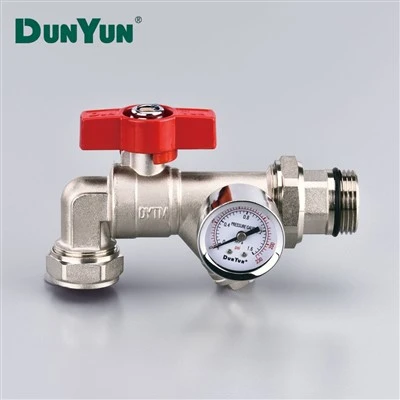
Hey there! As a supplier of PPR Brass Ball Valves, I often get asked whether these valves can be used in a chemical - handling system. It's a super important question, and today, I'm gonna break it down for you.
First off, let's understand what a PPR Brass Ball Valve is. PPR stands for Polypropylene Random Copolymer, which is a type of plastic known for its durability, flexibility, and resistance to corrosion. The brass part of the valve is usually the ball and the stem, which are crucial for controlling the flow of the fluid. The ball has a hole in it, and when you turn the valve handle, the ball rotates, either allowing the fluid to pass through (when the hole aligns with the pipe) or blocking it (when the solid part of the ball faces the pipe).
Now, let's talk about chemical - handling systems. These systems are designed to transport, store, and process various chemicals. The chemicals can range from mild acids and alkalis to highly corrosive and toxic substances. So, the valves used in these systems need to be able to withstand the chemical properties of the substances they're handling.
One of the main advantages of using a PPR Brass Ball Valve in a chemical - handling system is the PPR's chemical resistance. PPR is resistant to many common chemicals, such as weak acids, alkalis, and some organic solvents. This means that for less aggressive chemical applications, a PPR Brass Ball Valve can work just fine. For example, in a water treatment plant where they're using mild acids to adjust the pH level of the water, a PPR Brass Ball Valve can be a cost - effective and reliable choice.
However, not all chemicals are friendly to PPR and brass. Some strong acids and oxidizing agents can react with brass, causing it to corrode. Corrosion can lead to leaks, reduced valve performance, and even system failures. For instance, concentrated sulfuric acid can eat away at the brass components of the valve over time. So, if your chemical - handling system involves such aggressive chemicals, you might need to think twice before using a PPR Brass Ball Valve.
Another factor to consider is the temperature and pressure of the chemical - handling system. PPR has its limits when it comes to temperature. It can typically handle temperatures up to around 95°C (203°F). If the chemicals in your system are at a higher temperature, the PPR part of the valve might start to deform, which can affect the valve's sealing ability. Similarly, high - pressure applications can put a lot of stress on the valve. While PPR Brass Ball Valves are designed to handle a certain amount of pressure, extremely high - pressure systems might require a more heavy - duty valve.
But don't worry! If you're in a situation where you're not sure whether a PPR Brass Ball Valve is suitable for your chemical - handling system, we've got other options. We also offer Full - opening Brass Gate Valve, Magnetic Induction Locked Brass Gate Valve, and New Foot Diameter Brass Gate Valve. These valves are made of brass and are designed to handle different types of chemical - handling scenarios.
The full - opening brass gate valve provides a straight - through flow path, which is great for applications where you need a large flow capacity. The magnetic induction locked brass gate valve offers an extra level of security, which can be useful in systems where unauthorized access to the valve needs to be prevented. And the new foot diameter brass gate valve is designed to fit specific pipe sizes and can be a great option for custom - built chemical - handling systems.
When choosing a valve for your chemical - handling system, it's also important to consider the installation and maintenance requirements. PPR Brass Ball Valves are relatively easy to install. They can be connected to the pipes using solvent welding or mechanical fittings. Maintenance is also straightforward. You just need to check the valve periodically for any signs of wear or damage, and lubricate the moving parts if necessary.


In conclusion, a PPR Brass Ball Valve can be used in a chemical - handling system, but it depends on the type of chemicals, temperature, and pressure of the system. For less aggressive chemical applications, it can be a great choice. But for more demanding scenarios, you might need to explore other valve options.
If you're in the market for a valve for your chemical - handling system, I'd love to have a chat with you. We can discuss your specific requirements and find the best valve solution for you. Whether it's a PPR Brass Ball Valve or one of our other valve products, we're here to help you make the right decision.
References
- Chemical Resistance Guide for Plastics and Elastomers. A technical publication on material compatibility with various chemicals.
- Valve Handbook: A comprehensive guide on different types of valves, their applications, and performance characteristics.